
Wishing you a peaceful and sustainable Christmas
DCAN wishes all members and supporters a wonderful Christmas spent with family and friends, and a peaceful 2026 in which we see real and meaningful climate action.
Christmas is also a time when an extraordinary amount of “stuff” is bought, much of it never used. Research suggests that three in every ten Australians receive gifts they will never use, while food waste increases by around 30 per cent over the Christmas period. This makes it a good time to pause and think more carefully about what we buy. Simple choices can make a difference, such as giving edible treats or shared experiences instead of more “things”, buying second-hand, or making a donation to an aid or environmental organisation on behalf of a loved one.
Looking ahead, 2026 will bring many opportunities for DCAN to continue advocating for better climate decisions. We look forward to welcoming your ongoing help and support as we work together towards these goals.
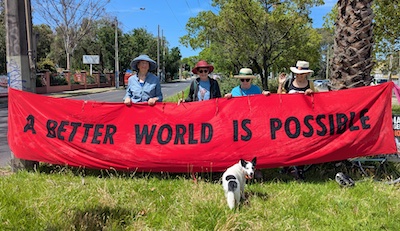
Help us make plans for 2026
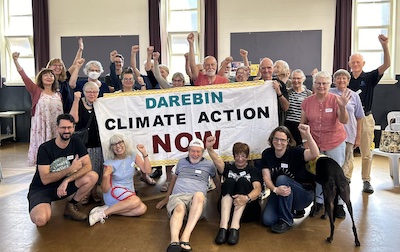
We are looking for fresh ideas and energy!
DCAN is holding its annual planning afternoon on Saturday 7th February and we would love to hear from you if you are interested in helping us plan for 2026. This chart gives an excellent picture of the work DCAN is involved in and suggestions for how new members can be involved. Drop us a line at [email protected] or give us a call: Ann on 0408 948 811 or Karen on 0425 753 266.
Tips for having calm climate conversations this holiday season

Holiday gatherings often bring up climate and energy topics, and these conversations can get heated quickly. A calm, practical approach can help keep things respectful and grounded in shared values.
Ask first, don’t challenge.
Try questions like: “What worries you most about switching off gas?” Listening first helps lower defences.
Focus on everyday values.
People usually care about bills, comfort and health. Frame electrification as practical, with better efficiency, lower running costs and cleaner indoor air.
Share facts, not sermons.
Offer a credible article rather than asserting you are right. A simple “I read something on this and can send it if you like” goes a long way.
Pick your moment.
If someone becomes defensive, it is okay to pause or change the subject. Holiday tables are not the place to settle everything.
You may not change minds in one conversation, but staying calm and respectful can plant a seed that grows over time.
All I want for Christmas.... is a cheaper home battery!

DCAN welcomes the significant expansion of the Federal Government’s Cheaper Home Batteries program. The program has been a stunning success with more than 155,000 households and small businesses installing batteries in less than six months. This helps families cut power bills, reduce peak demand, and take control of their energy use. Most importantly, batteries are good for reducing climate pollution.
Confused about where to start? Why not have a chat with DCAN volunteer Graham Moore. Graham provides a free one-on-one home energy advice service on behalf of DCAN. To organise a chat with Graham fill out this form.
Help change the national story on heat

Australia’s biggest community survey on heat is back and your voice is needed! For most people, heatwaves don’t look like a carefree summer’s day, they look like sleepless nights, sweltering homes, unsafe workplaces, and power bills that make staying cool feel impossible.
Across Australia, people are struggling through hotter summers, and your story is essential in revealing the real impacts of heat on our homes, health and everyday lives. Sweltering Cities is the national community voice for heat safety and is running the survey. You can fill out the survey here.
New nature laws - some positives but also big gaps & much more to do!
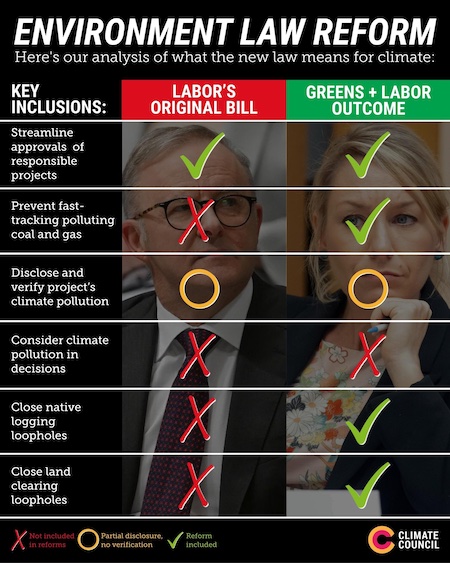
Thank you to everyone who contacted MPs and Senators' offices in the campaign to strengthen our national environment laws. The newly-passed Environmental Protection and Biodiversity Conservation Act has some important improvements but still fails the climate test. Incredibly, climate pollution won't be taken into account in decisions on new projects.
As the The Climate Council says, "until emissions are fully accounted for and climate impacts properly weighed, our forests, our future, and our climate remain at risk". DCAN will continue our fight to stop the Albanese Government from approving new gas and coal projects. Early in 2026, we will be making submissions on the drafts of the first two National Environmental Standards, which are the backbone of the new legislation. Let us know if you would like to join us in fighting to improve the laws.
Working with affected communities to prevent toxic waste-to-energy incinerators
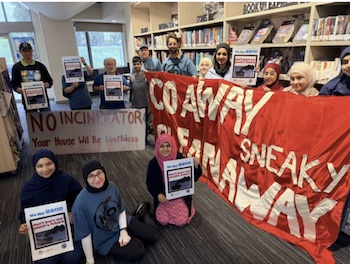
Local communities are escalating their opposition to five proposed so-called “waste-to-energy” incinerators and a toxic ash dump planned for Melbourne’s outer suburbs and the Latrobe Valley. Community groups have raised serious concerns about the health, environmental, and climate impacts of these developments.
The photo shows a protest outside a Cleanaway information session on the proposed incinerator at Wollert, near Epping. Around 20 community members gathered outside the venue, while not a single local resident attended the so-called consultation inside, highlighting the growing frustration with what many see as a tokenistic engagement process.
The proposed incinerators pose serious health risks by polluting air, water, and soil in nearby homes and schools. Darebin Council has stated its opposition to waste-to-energy incinerators, so we can assume that Darebin’s waste will not be transported north of Epping to be burned. Even so, many local residents could still be affected. Toxic exhaust emissions from the proposed Wollert facility could travel as far as Reservoir and are uncomfortably close to the Greenvale and Yan Yean reservoirs, which supply drinking water to parts of Melbourne.
This is more than a local pollution issue. To address the climate emergency, we must move toward a circular economy that dramatically reduces waste. If councils enter long-term contracts with incinerator companies, they risk being locked into supplying fixed volumes of rubbish for decades, undermining efforts to reduce waste and emissions.
Read more about this issue on the ABC website and on Zero Waste Australia. You can also follow the campaign by searching for NO Northern Incinerator Wollert on Facebook.
Data centres: a growing climate and water challenge
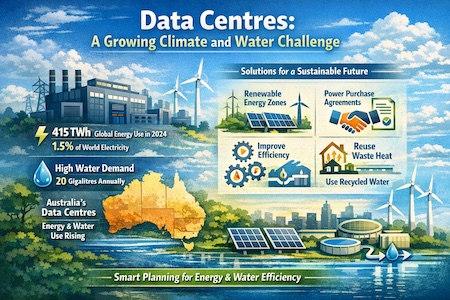
Data centres are rapidly becoming a major driver of electricity and water demand worldwide. The International Energy Agency estimates that in 2024 they consumed around 1.5% of global demand — growing at 12% per year. By 2030, data centres could account for close to 10% of electricity use in some regions, with impacts amplified because they are often concentrated in specific locations rather than spread across the grid. Importantly, high-efficiency design could limit global electricity use to 2.6% instead of 4.4%. In Australia, data centres already consume about 2% of grid electricity, with demand expected to triple by 2030.
Water use is also significant: proposed centres in Greater Melbourne alone have sought nearly 20 gigalitres per year, equivalent to the water needs of 330,000 people.
Climate groups argue that strong regulation is essential. Solutions include co-locating data centres in renewable energy zones, securing clean power through long-term agreements, improving efficiency, shifting workloads to times of abundant renewable energy, reusing waste heat, and sourcing cooling water from treated wastewater.
While Australia’s new National AI Plan allows fast-tracking of data centres linked to renewables, experts warn that robust environmental assessment and reporting frameworks are still lacking — a critical gap as the sector expands.
Rising Tide shuts down the world’s largest coal port for a weekend
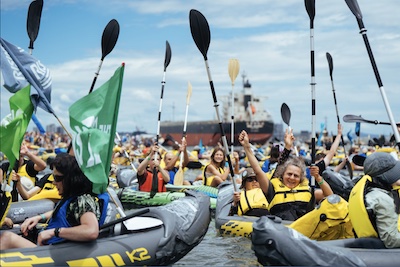
Eight thousand people (including a few DCAN supporters) headed to Newcastle for the Rising Tide ‘protestival’ in early December. Police had designated most of the port as an exclusion zone, but wave after wave of kayakers and swimmers risked arrest by entering the shipping channel, causing major disruption. Of the 15 coal ships scheduled to arrive over the weekend, 10 were rescheduled and 3 were turned around. Greenpeace activists climbed up the anchor chain of a coal ship waiting outside the port and dropped a banner calling for an end to coal and gas. There was music, a large range of interesting workshops and an uplifting community spirit. There are more pictures and stories from the People’s Blockade here.
The next phase of the campaign will feature even more disruption. If you’d like to be part of this important campaign, join the Rising Tide mailing list.
Climate Choir entertains locals in Fairfield
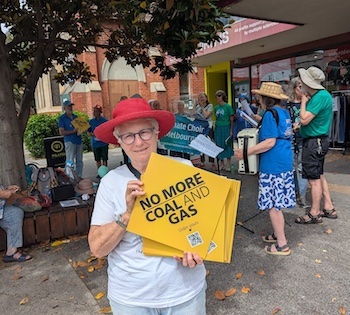
Once again it was a joy to see the Climate Choir Melbourne in full song at the Fairfield Village shopping centre on a busy Saturday morning in December. Locals were entertained with clever and cheeky climate lyrics sung to well known tunes. Our No More Gas and Coal fence signs were very popular with 30 signs given out during the hour long event. If you would like a sign for your fence or front window please email Katherine.
Help researchers understand our emotional responses to the extinction crisis
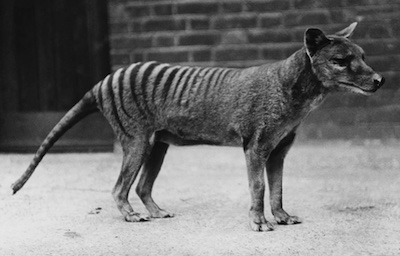
Environment groups face a growing challenge in conveying the true urgency of the extinction crisis. You can help by supporting researchers at RMIT University and their research partners through a short online survey that explores how people respond emotionally to images of animals.
The survey takes around ten minutes to complete. You will be shown a range of animal images and asked to choose two or three that resonate with you. Using a simple emotion chart, you can then select the feelings those images evoke, choosing only the emotions you wish to share.
Your responses will help researchers better understand how emotional connections can strengthen communication and action around biodiversity loss. You can learn more about the project at the Circles of Extinction website.
Support our work in 2026 and beyond
Help DCAN Grow on Social Media!
Exciting news! DCAN is now on Instagram and Bluesky in addition to Facebook, and we’d love you to join us there. By following and engaging with our posts, you help spread the word about climate action in our community.
 Instagram – See inspiring photos, event updates, and climate tips. darebin_climate_action
 Bluesky – Join the conversation on policies, actions, and solutions. @darebincan.bsky.social
 Facebook – Keep up to date with DCAN activities and climate news. www.facebook.com/DarebinCAN
Every like, comment, and share helps amplify our impact. Follow us today and be part of the movement for a greener future! Please email us if you would like to join the DCAN social media team.
Want to know more about DCAN?
Why not come along to one of our monthly meetings? We usually meet on the second Thursday of each month at 7.00pm at the Bridge Preston. Please drop us an email at [email protected] to let us know if you are coming so that we can make sure to welcome you and give you an agenda ahead of the meeting.
Our next meeting will be at 7:00 pm on February 12th, 2026 in the Waratah Room at the Bridge, 261 High, Preston.
-
 Keith Talbot published this page in News 2025-12-20 08:19:08 +1100